Statutory Compliance Architecture for the Pennsylvania Wiretap Act
Pennsylvania is an all-party consent jurisdiction. Under 18 Pa.C.S. § 5703, intentionally intercepting, disclosing, or using a wire, electronic, or oral communication without the consent of every party is a felony of the third degree. Section 5702 defines an oral communication as one uttered by a person possessing an expectation that it is not subject to interception under circumstances justifying that expectation. A closed primary care exam room satisfies that test almost without exception.
The operative safe harbor is § 5704(4), which permits interception where all parties to the communication have given prior consent. Two words carry the compliance weight: 'all' and 'prior.' Consent from the patient alone is insufficient when a spouse, adult child, interpreter, or medical student is present, and consent obtained after the microphone opens cannot retroactively cure an interception. Civil exposure under § 5725 adds actual damages, liquidated damages of the greater of $100 per day or $1,000, punitive damages, and attorney fees.
Why Volatile Memory Still Counts as Interception
The statutory trigger is acquisition, not storage. Merry AI processes visit audio exclusively in volatile RAM and zeroizes buffers at note signing, which eliminates disk persistence, subpoenable audio archives, and secondary training corpora. That architecture materially reduces breach and discovery risk, but it does not convert an interception into a non-interception. Capturing speech into memory and using it to generate a note is still 'use' under § 5703, so prior all-party consent remains mandatory regardless of retention period.
Consent Workflow and Timestamped Attestation in Primary Care
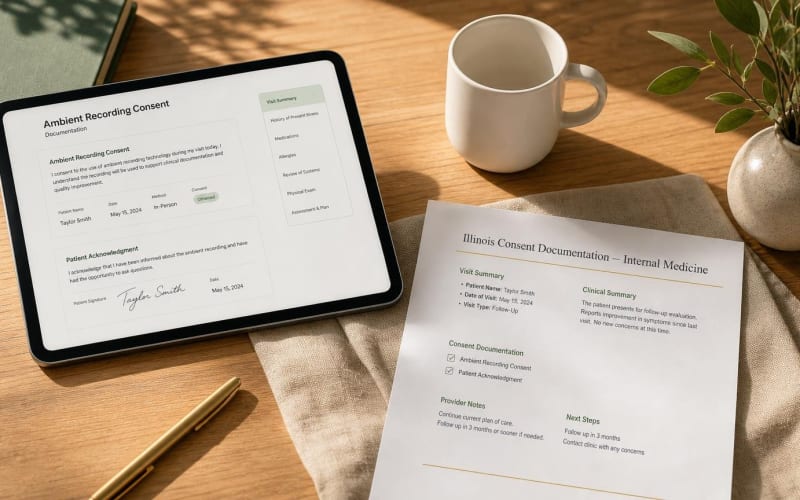
Directive P1 governs pipeline activation: verbal consent must be recorded from every party present before ambient capture begins. In practice, the rooming clinician or physician states, in plain language, that clinical conversation will be processed by software to draft documentation, that no audio is retained after the note is signed, and that any party may decline. Each person present answers affirmatively. Only then does the clinician engage the consent toggle, which unlocks the audio pipeline.
Primary care visits frequently change composition mid-encounter. A caregiver may enter during medication reconciliation, or a nurse may join for a procedure. Merry AI pauses capture when the clinician flags a new participant and requires a fresh consent confirmation before resuming. The attestation then records the participant count at each consent event, preserving the 'all parties' element for the full duration of interception rather than only its opening seconds.
DOM Injection Into the Note Header Field
Directive P7 requires durable evidence. Although § 5704(4) does not mandate written consent, contemporaneous documentation inside the signed encounter note is highly probative in any later dispute. The browser extension identifies the designated header or administrative field within the EHR charting DOM, whether a textarea, a contenteditable region, or an editor nested within an iframe, and injects a standardized statement: 'Consent attestation: 2026-10-19 09:42:17 EDT. All parties present (3) verbally consented prior to ambient audio processing per 18 Pa.C.S. § 5704(4). Audio processed in volatile memory only; purged at signature.' The extension confirms buffer purge before finalizing the string and never writes into orders, structured diagnoses, or problem-list codes.
Statutory Comparison: Manual, Generic, and Merry AI Documentation
Each documentation model distributes Wiretap exposure differently. The comparison below evaluates the elements a Pennsylvania auditor, plaintiff, or compliance officer would examine first.
| Compliance Dimension | Manual Charting | Standard Generic AI Scribes | Merry AI Compliance Architecture |
|---|---|---|---|
| § 5704(4) prior all-party consent | Not triggered; no interception | Clinic-dependent; often patient-only | Pipeline locked until all-party consent toggle |
| Audio retention | None | Hours to indefinite; vendor-defined | Volatile RAM only; purged at signature |
| Consent evidence in note | Not applicable | Rarely encounter-level | Timestamped header attestation (P7) |
| Secondary use or model training | None | Permitted under some terms | Prohibited; no raw audio corpus |
| § 5725 civil exposure | Minimal | Elevated if consent undocumented | Reduced through contemporaneous proof |
| G2211 and modifier 25 separation | Clinician-dependent | Consent text may enter narrative | Attestation isolated from MDM |
Generic ambient scribes commonly retain audio or transcripts for redrafting, quality review, or model improvement, and many return notes through standalone applications that clinicians paste into the narrative. That pattern scatters consent evidence across policy documents and leaves no encounter-level proof that every party agreed before capture.
Billing Integrity: G2211 and NCCI Modifiers 25/59
HCPCS G2211 reflects longitudinal complexity for office/outpatient E/M services (99202-99205, 99211-99215) that serve as the continuing focal point for care or address a single serious or complex condition. CMS generally does not pay G2211 when the base E/M carries modifier 25, except when the same-day service is an annual wellness visit, vaccine administration, or a listed Part B preventive service. Modifier 25 requires a significant, separately identifiable E/M, while modifier 59 is never appended to E/M lines.
Separating Consent Text From Medical Decision-Making
Consent language must remain administrative. If attestation text bleeds into the HPI or assessment, an auditor reviewing a modifier 25 claim may question whether the narrative reflects genuine, distinct clinical work. Merry AI confines the attestation to the header field so that DSM-5-TR symptom criteria, NYHA class and LVEF values, range-of-motion degrees, and Bright Futures anticipatory guidance remain cleanly readable as medical necessity documentation supporting G2211 and same-day procedure claims.
Clinician attestation remains the final safeguard. The signing physician reviews every generated sentence, corrects transcription of numeric values, and accepts legal authorship before the purge event fires. Peer-reviewed literature on ambient documentation accuracy and consent practice is indexed at https://www.ncbi.nlm.nih.gov/pmc/ for internal policy committees.
Practices preparing for deployment can Schedule a 15-Minute Workflow Audit to map consent scripts, participant-change handling, and header-field placement against their specific EHR configuration.